
Insider trade filings
Every insider trade, with the context the filing already encoded.
Insider trade filings are dense by design. Insider Oracle separates equity and derivative trades, decodes transaction codes, and exposes footnotes inline — so every print arrives with the context the filer actually attached to it.
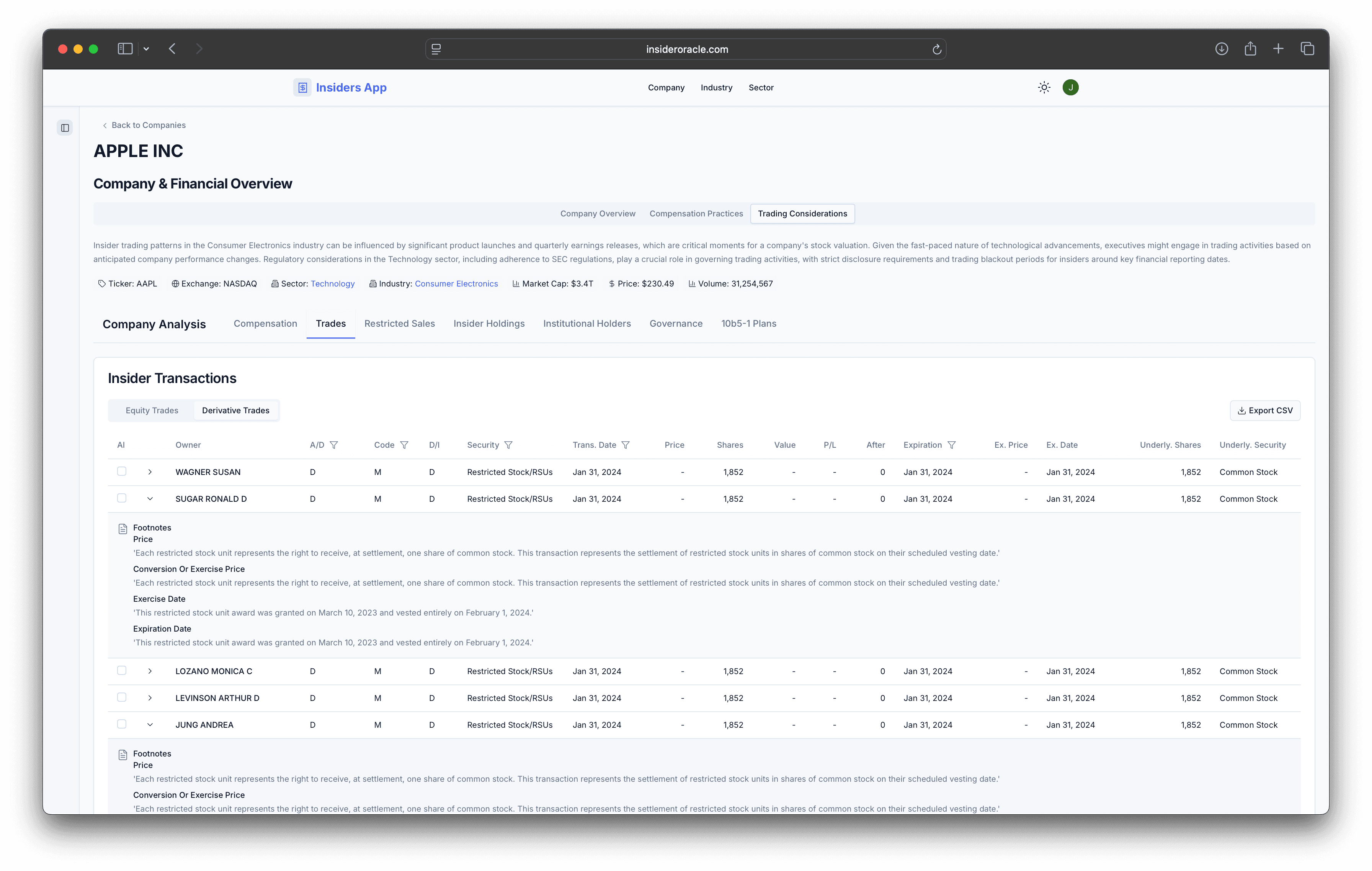

Equity and derivative trades split into distinct, filterable tables
Date, security-code, security-title, and insider filters built in
Footnotes expandable per row instead of buried in raw filings
Why it matters
Most readers stop at the headline. The detail is where the story lives.
A 'sale' coded as a tax withholding event is not the same as a discretionary disposal. A purchase under a 10b5-1 plan is not the same as an opportunistic buy. Insider trades only become useful once the codes, securities, and footnotes are legible.
Workflow
Search, filter, sort, and pivot — without leaving the company.
The trades tab supports paginated tables (15 rows per page), date-range filters, security-code and security-title filters, and an insider filter. Use Add to AI on any row to get a plain-language summary, or export the filtered set to CSV.
Insider Oracle edge
How Insider Oracle does this better
Equity vs derivative is a first-class split
We don't blend the two. Each gets its own table with the right columns for that kind of activity.
Footnotes are inline, not lost
Filers attach context for a reason. We make it accessible at the row level instead of asking you to chase the source filing.
One click from a trade to the position behind it
From any trade you can pivot to the historical-holdings comparison and see whether the print actually moved the position.
Go deeper
Read every insider trade with the qualifications already attached.
Stop guessing whether a trade was discretionary. See the codes, footnotes, and context together — then pivot to holdings to see what actually changed.